🔌Travel Adapters Compared: What You Actually Need


TLDR
- Beyond the Plug: Not all travel adapters are the same: plug type, voltage, and wattage matter more than most people think.
- Convenience vs. Quality: Universal adapters are convenient, but they are not always the most durable or safest option for expensive gear.
- Dual Voltage: Most modern devices support dual voltage, but high-power appliances often do not and can fry without a converter.
- Essential Ports: USB-C and multi-port adapters are now essential for remote workers and digital nomads managing multiple gadgets.
- Workflow Win: Choosing the right adapter setup reduces risk, saves space, and simplifies your entire travel workflow.
If you have ever landed in a new country, unpacked your laptop, and realized your charger does not fit the socket, you already understand the problem.
Travel adapters seem simple at first. Just buy one and you are good, right? Not quite. Different countries use different plug types, some run on different voltages, and not all units are built to handle the devices you rely on every day.
If you are traveling long-term, especially as a digital nomad, your setup needs to be intentional. Let’s break down the best travel adapters so you can avoid the usual headaches.
🔌 Plug Types: The First Thing Everyone Notices
Globally, there are more than a dozen plug types, but most travelers will encounter a handful repeatedly. Europe commonly uses Type C, E, and F. The UK uses Type G. The US uses Type A and B. Southeast Asia is a mix, depending on the country.
Adapters simply allow your plug to physically fit into a foreign socket. This distinction matters because a standard adapter does not convert electricity. To ensure you stay powered up while exploring, it helps to check a guide to global plug types before you land.
| Region | Common Plug Types | Voltage Range |
| North America | Type A, B | 110–120V |
| Europe / South America | Type C, E, F | 220–240V |
| UK / Hong Kong | Type G | 220–240V |
| Australia / China | Type I | 220–240V |
⚡ Voltage Differences: The Overlooked Risk
While plug shape is obvious, voltage is where things can go wrong. Most countries operate on either 110–120V or 220–240V. Using a device that is not compatible with the local voltage can damage it instantly.
The good news? Most modern electronics like phones and best laptops for remote work are dual voltage (100–240V). However, hair dryers and kitchen appliances often are not. If you are bringing high-power devices, you may need a voltage converter, not just a travel adapter with USB-C.
💡 Expert Tip: Check the “Input” section on your device’s power brick. If it says 100-240V, you only need an adapter. If it only says 110V or 230V, do not plug it in abroad without a converter.
🛠️ Types of Best World Travel Adapters 2026
There is no single “best” adapter; it depends on how and where you travel.
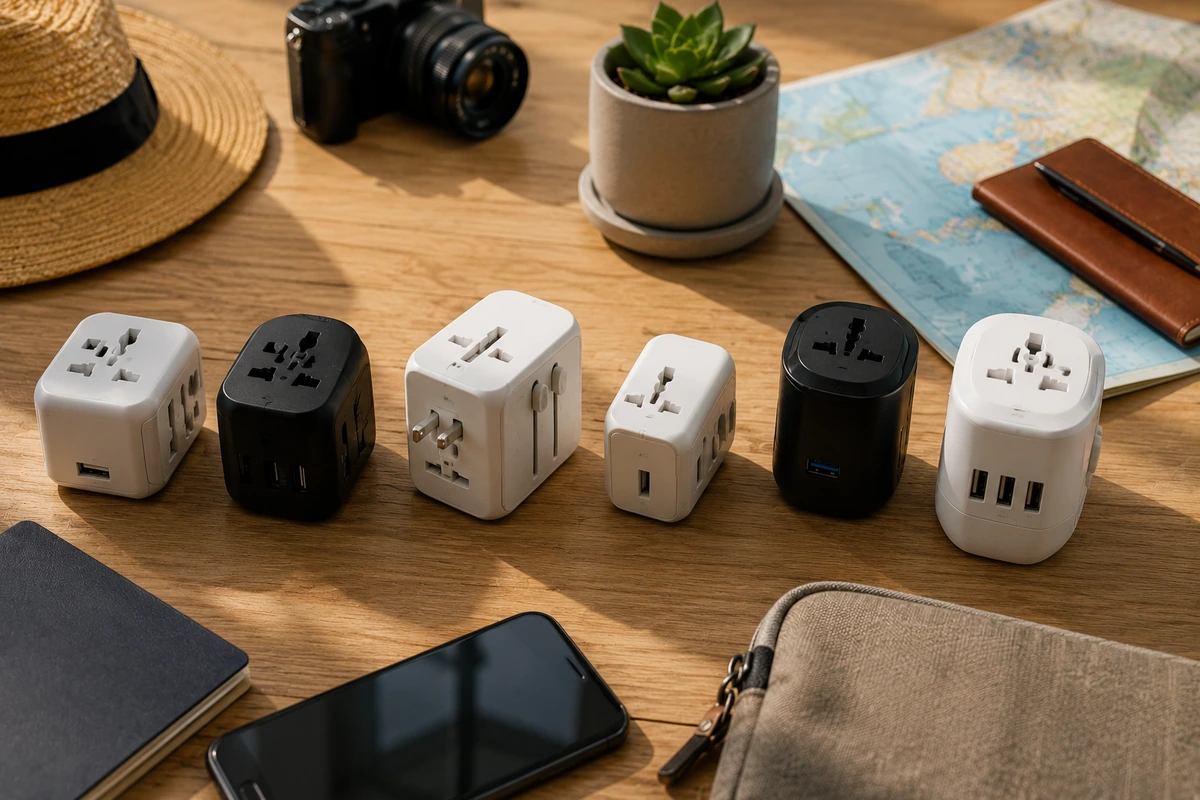
- Universal Travel Adapters: These include multiple configurations in one unit. They are the most popular multi country travel adapters because you slide out the pins you need.
- Region-Specific Adapters: Simple, durable, and cheap. Use these if you are staying in one area, like moving between best coworking spaces in Southeast Asia.
- Multi-Port USB Adapters: These have evolved into a nomad favorite. A travel adapter with USB-C allows you to charge several devices from a single outlet, reducing the number of individual chargers you need to carry in your best travel backpack.
💻 What Digital Nomads Actually Need
For long-term travel, your setup should be more robust than a vacationer’s. Here is the blueprint for the best adapters for international travel:
1. A Reliable Universal Adapter
This is your baseline. Look for one with solid build quality and an internal fuse. Cheap, flimsy universal travel adapters for nomads can spark or fall out of loose wall sockets.
2. Fast Charging Travel Adapters
Your time is money. Look for units that support Power Delivery (PD) through USB-C. This is essential if you are using high-draw devices or portable monitors for digital nomads to maintain a dual-screen setup on the road.
3. Lightweight Travel Plugs
If you are sticking to one region, carry a few lightweight travel plugs for nomads. They take up less space than a bulky universal block and tend to hold more securely in older wall outlets.
💡 Expert Tip: Carry a small power strip from your home country. This way, you only need one adapter for the wall, but you can plug in all your familiar devices at once. This is one of the 15 gadgets every digital nomad needs to stay organized.
⚠️ Common Mistakes to Avoid
A few issues come up again and again. First, buying the cheapest option. Poor build quality can lead to overheating or electrical hazards. Second, ignoring wattage limits. If you are running a high-wattage laptop and multiple devices, ensure your adapter can handle the load.
Finally, overcomplicating. You do not need to prepare for every possible scenario. One high-quality fast charging travel adapter and one backup is usually enough. For more on streamlining your life, check out the ultimate guide to productivity apps.
👋 Conclusion
Travel adapters are not exciting, but they are the bridge between you and your income. Choosing the best world travel adapters 2026 is about understanding your gear’s requirements.
Once your power setup is sorted, it fades into the background. That allows you to focus on the work, the travel, and the freedom you are building. Just remember to pack your adapter in your carry-on; you do not want to be stuck at a layover with a dead phone and a charger that does not fit.
Read Also: Safety Tips for Solo Digital Nomads