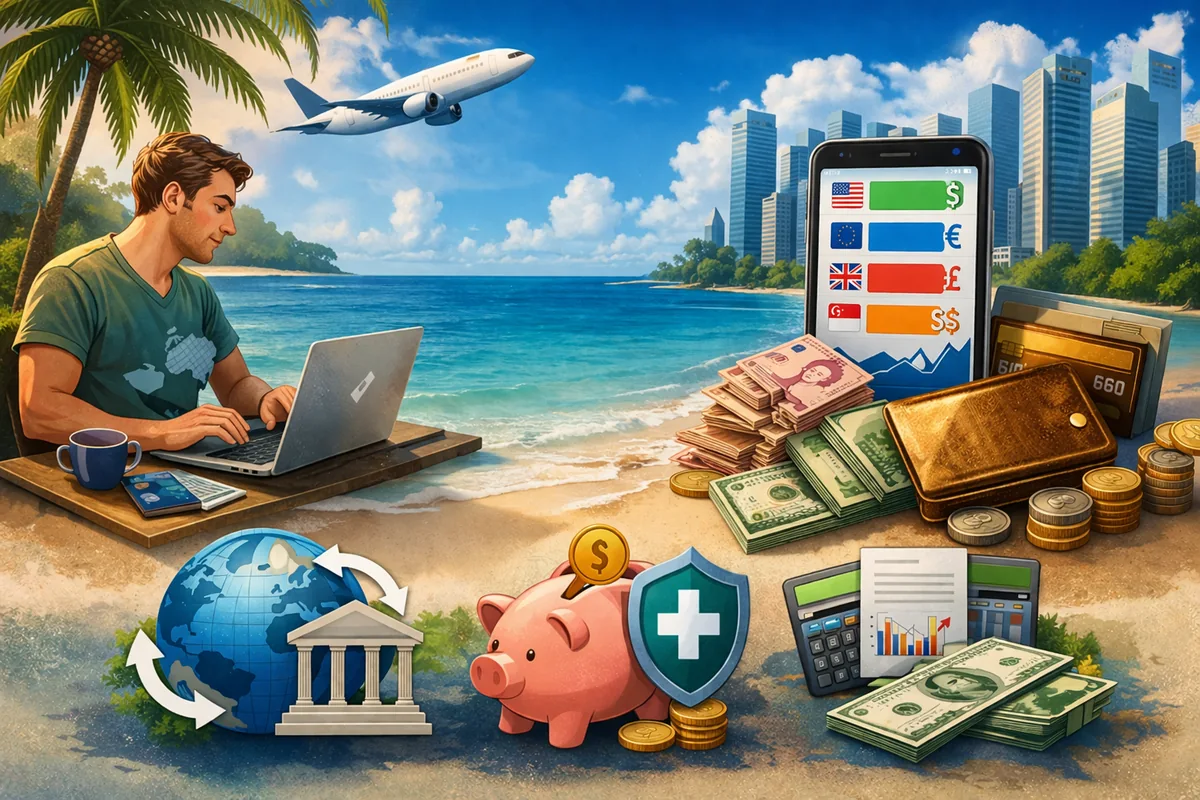
Digital Nomad Finance 101: How to Manage Money While Traveling


Key Take-Aways
- Go Digital: Use multi-currency accounts (Wise, Revolut) to slash conversion fees.
- Track It: Review expenses weekly to stay within your cost of living targets.
- Stay Safe: Build a 3–6 month emergency fund before heading to your next destination.
- Local Wins: Always pay in the local currency at ATMs to avoid “dynamic” markups.
- Double Up: Use two-factor authentication (2FA) and carry redundant backup cards.
Managing money as a digital nomad is very different from just “normal” money management. You definitely need to have a system down, especially if your location changes every so often.
Your financial setup, however you choose to structure it, needs to be stable enough to handle frequent trips, changes in currency and unexpected costs.
If you don’t have one base, but rather a few (or none), small financial mistakes can have large ramifications. Foreign transaction fees that become slightly higher, sloppy budgeting or an oversight in your travel expenses can quietly (or loudly!) drain a significant sum over time.
That’s why I can advise every single nomad out there to build a simple yet resilient structure, so that money becomes one less thing to worry about, allowing you to focus on your multiple income streams (you do have multiple, right?!) and living well.
In this practical guide, I’ll go over how to manage your finances while traveling, focused strongly on setting up a solid structure, managing your risks and creating long-term sustainability.
Start With the Right Banking Setup
You can’t get over banking, it’s the primary “hub” of your finances, no matter where you are. The days where everyone uses crypto are still far ahead of us!
However, traditional domestic bank accounts almost always charge foreign transaction fees, ATM fees, and other fees when you use them abroad. These small costs compound quickly if you spend months outside your home country.
As a personal example: the first year I was in the Philippines, I used my European credit cards to withdraw pesos from the ATMs here… costing me about €5 every time.
Pocket change, you might say… but afterwards I did the calculations and the money I spent on fees was enough to cover multiple months of rent here. Yeah, fees matter.
Of course, these days you’ve got many better options, and many digital nomads rely on banks or financial technology platforms that support multi-currency accounts, such as Wise (my personal favorite).
This allows you to easily keep balances in different currencies and convert at competitive rates, and it’s an integral part of my nomad banking guide.
The goal with such an account is simple and straightforward: minimize friction and hidden (or apparent) fees. Keep more of your money, in other words.
Digital Nomad Financial Planning: The Framework
As a digital nomad, one of your biggest advantages is flexibility: where and when you work, live, love and are based.
It’s wonderful, but that doesn’t mean that your digital nomad financial planning should be random… you need a solid structure.
By this I mean: set up a structured monthly budget, which details exactly what and how much you (can) spend on housing, food, fun, transport, and international health insurance.
Top International Money Management Tool
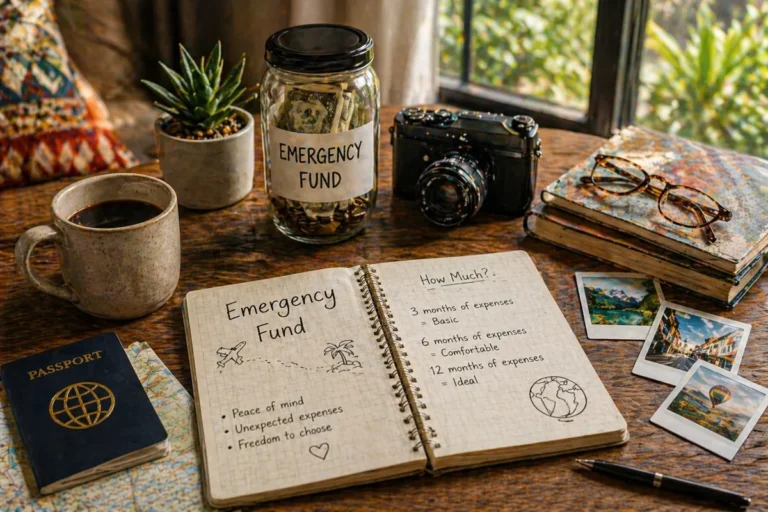
Establish an Emergency Fund Before You Travel
I’ve been active in the financial planning sector for over a decade, and one of the core principles I teach everyone, something I really hammer down, is to have an emergency fund.
You wouldn’t believe how many people can’t even amass $ 1,000 in an emergency… to me, that’s goddamn lunacy. How can you live like that without constantly being anxious?
(Well, maybe that partly explains the high amount of mental health issues in the Western world these days… But I digress!)
While an emergency fund is absolutely required for everyone, I’d say it’s even more so (doubly absolute?) for mobile nomads.
Flights get canceled (happened to me just last month), laptops break down, medical situations happen, the list of potential unexpected and costly situations is nearly endless.
Before committing to, for example, moving to Colombia or other remote hubs where … stuff … can happen, ensure you have at least three to six months of expenses in a liquid savings account.
Personally, I keep half of it in cash, both EUR and USD, spread across my possessions, because digital accounts can have problems of their own.
For nomads, such a fund becomes even more critical because you almost always do not yet have local support systems in place, such as a local bank account.
Keep this money separate from your daily spending account. Mentally and practically, it should be protected and only used when a true crisis occurs.
Reduce Foreign Transaction Fees
Foreign transaction fees typically range from 1% to 3% per purchase, or a flat fee (like in my example before).
That may sound small, but over a year of international spending, it adds up to thousands of dollars in lost capital, as I said.
Using debit or credit cards that waive these fees is one of the simplest upgrades you can make, but that’s easier said than done with “normal” bank accounts from your home country.
Luckily, many international travel-focused cards offer this feature. If you are successful in avoiding foreign transaction fees while traveling, you are effectively giving yourself an X% raise on every dollar spent abroad!
The Best Way to Receive International Payments
If you are a freelancer, receiving money across borders is unfortunately always a pretty expensive part of your business, because it cuts down on your net profit.
That’s why I’d recommend you to consider the following options to receive international payments:
- Wise: Still the industry standard for receiving USD, EUR, and GBP with low transparent fees. My personal favorite!
- Stablecoins: Research from The Payment Association shows that stablecoin transaction volumes have increased significantly year-on-year. While you shouldn’t just head-first into the world of crypto, it can provide you a near-instant settlement layer for remote contractors if you know what you’re doing.
Always Pay in Local Currency
And now we come to a simple, yet extremely elegant solution for those of us who are “long-term” nomads, i.e. nomads who pick a base to live in for years. Travel still occurs often, but it’s centered around that base, and you return often to it. It is your de facto home.
In such a scenario, having a local bank account is an absolute must. You’ll save so much money, and it provides you with additional financial security against inflation or currency devaluations of your “base” currency.
In addition, and this goes for every nomad, long or short term: when paying with a credit card abroad, you are often asked if you want to pay in your home currency or the local currency.
It goes without saying that you should always pick the local currency, to avoid “Dynamic Currency Conversion”, which allows the local merchant’s bank to set the exchange rate – which is always too high.
Paying in local currency allows your own bank or card network to apply its rate, which is almost always more favorable.
It may seem like a small decision when paying for something, and you won’t notice it greatly per transaction, but over time and over many transactions it is a massive drain, and as such this principle is a cornerstone of how to manage money while traveling.
Nomad Tax Strategies for Beginners
I absolutely abhor taxes. I really, really hate them. I think they’re nothing more “legal” theft and that governments can fuck right off with taking 50%+ of your income.
That being said, philosophical and emotional arguments aside, there’s the unfortunate reality to consider: you shouldn’t do anything illegal, and thus if you have to pay taxes, you should.
Not because it’s “right”, but because not doing so can cause you a lot of problems, the least of which are financial, and the worst would be loss of your freedom.
I’ve done a lot to minimize the amount of taxes I have to legally pay, and I’m very pleased by the result (keeping 99% of my income) – something you can achieve too as a nomad.
Now, it’s important to realize that traveling or living in another country does not automatically eliminate tax responsibilities in your home country.
Tax rules broadly depend on your citizenship, residency, and income sources.
- 183-Day Rule: Most countries claim you as a tax resident if you spend more than half the year (183+ days) there. You can thus avoid being taxed anywhere if you just spend 180 days in one country, 180 days in another, and a short holiday in another. However, as noted by IMI Daily’s 2026 analysis, many jurisdictions now use “center of vital interests” tests that can trigger residency even if you stay for fewer days. This is rather vague and can easily be avoided, but it’s something to keep in mind.
- U.S. Citizens: If you’re a citizen of the Land of the Free, you’re ironically WAY less free than citizens of almost every other country. Regardless of where you live and for how long, if you keep your U.S. Citizenship, you have to keep paying taxes to your government. Isn’t that wonderful. However, the Internal Revenue Service (IRS) has set the Foreign Earned Income Exclusion (FEIE) limit at $132,900 – that means that you only have to pay taxes if your income goes above that number. What a relief.
- Income Sources: There are quite a few countries that do not tax you at all on international income sources, i.e. income that doesn’t come from that country. Paraguay is a good example, and it’s why it’s one of my main bases.
Protect Your Accounts and Maintain Redundancy
Public WiFi in airports and cafes is a major security risk. I’d recommend you don’t use it all, if you really don’t have to, and especially not for financial stuff.
If you do absolutely have to, for example having to buy a new ticket in an airport (I’ve been in that situation), absolutely ensure your best VPN for digital nomads is active before logging into banking portals. I can recommend NordVPN.
And of course, regardless of where you are, always use two-factor authentication (2FA) on all financial accounts. Authenticator apps (I use Google Authenticator) offer much stronger protection than SMS codes.
Also, I’m a huge advocate of redundancy in your life: never rely on a single something. A single country, a single phone, a single flash drive with your data, a single bank account, a single credit card… if you lose it or access to it, you’re screwed.
The most relevant advice in this topic is to carry at least two debit or credit cards from different banks/digital accounts and store them separately.
Redundancy is not paranoia, it’s professional risk management for those who want to sleep soundly.
Final Thoughts
I hope it’s clear now that you can easily and safely manage money while traveling by focusing on clarity, structure, and fee reduction.
Choose the right banking tools, ensure you have a cost of living tracking for travelers, and do your best to minimize your tax obligations.
When your financial system is solid, mobility becomes a genuine advantage rather than a source of stress.