Best Cities for Digital Nomads (Cost Breakdown)
TLDR
- Southeast Asia and parts of Eastern Europe remain the most cost-efficient regions for digital nomads
- Monthly living costs vary widely, from around $800 in budget cities to $2,500+ in premium hubs
- Accommodation is the biggest variable, often accounting for 30 to 50 percent of total expenses
- Cities with strong infrastructure and visa flexibility tend to offer better long-term value
- The “best” city depends on your balance between cost, lifestyle, and work requirements
Choosing where to base yourself as a digital nomad is rarely just about picking somewhere cheap. Cost matters, of course, but it’s only one piece of the puzzle.
You also need reliable internet, decent infrastructure, a comfortable living environment, and ideally a community that makes it easy to settle in. The tricky part is finding a place that balances all of that without quietly draining your budget.
After spending time across different regions, you start to notice a pattern. Some cities punch far above their weight in terms of value, while others look attractive on paper but end up costing more than expected.
Let’s break down some of the most popular cities for digital nomads, focusing on realistic monthly costs and what you actually get for your money.
Chiang Mai, Thailand
Chiang Mai has been a staple in the nomad world for years, and it still holds up surprisingly well.
A comfortable monthly budget here typically ranges between $800 and $1,500, depending on your lifestyle. A modern apartment can cost anywhere from $300 to $700, while local food remains very affordable if you eat Thai regularly.
Internet speeds are generally reliable, and coworking spaces are widely available. The city also has a well-established nomad community, which makes it easier to connect with others.
The trade-off is that it’s not as dynamic as larger cities. If you need constant stimulation or nightlife, it might feel a bit slow after a while.
Bali, Indonesia
Bali, Indonesia, offers a mix of affordability and lifestyle appeal, though costs have risen in recent years.
In areas like Canggu or Ubud, a realistic monthly budget falls between $1,200 and $2,000. Accommodation is the biggest variable here. You can find basic options for around $500, but more comfortable villas can easily exceed $1,200 per month.
Food ranges from very cheap local meals to higher-priced international options. Internet quality has improved significantly, especially in coworking spaces, though it can still be inconsistent in some villas.
What keeps people coming back is the lifestyle. Surf, cafés, community, and a generally relaxed pace make it easy to settle in.
Ho Chi Minh City, Vietnam
If you’re looking for value, Ho Chi Minh City is hard to beat.
A monthly budget of $900 to $1,600 covers a comfortable lifestyle. Rent for a modern serviced apartment often sits between $400 and $900, depending on location and amenities.
Food is extremely affordable if you stick to local options, and even Western meals are reasonably priced compared to many other countries. Internet speeds are fast and widely available.
The city itself is busy and chaotic. Traffic can be overwhelming at first, but many people adapt quickly and end up enjoying the energy.
Lisbon, Portugal
Lisbon is one of the more expensive options on this list, but it offers a different kind of value.
A realistic monthly budget ranges from $1,800 to $3,000. Rent is the main driver of costs, with one-bedroom apartments often starting around $1,200 and going much higher in central areas.
Food, transport, and coworking spaces add to the total, though they remain manageable compared to other Western European cities.
What you get in return is strong infrastructure, a high quality of life, and easy access to the rest of Europe. For many nomads, that trade-off makes sense.
Medellín, Colombia
Medellín has become one of the top choices in Latin America, especially for long-term stays.
Monthly costs typically fall between $1,200 and $2,000. Rent in popular areas like El Poblado ranges from $600 to $1,200 for a comfortable apartment.
The city offers good internet, a growing coworking scene, and a pleasant climate year-round. Food and transportation are also reasonably priced.
Safety has improved significantly over the years, though it’s still important to stay aware of your surroundings and follow basic precautions.
Tbilisi, Georgia
Tbilisi often flies under the radar, but it offers strong value for digital nomads.
You can live comfortably on $900 to $1,500 per month. Rent is relatively low, with apartments often available between $400 and $800.
The city has reliable internet, a unique cultural mix, and a visa policy that allows many nationalities to stay for up to a year.
It’s not as polished as some other destinations, but that’s part of the appeal. It feels a bit more raw and less commercialized.
Mexico City, Mexico
Mexico City offers a balance between cost, culture, and connectivity.
A monthly budget of $1,500 to $2,500 is realistic, depending on your neighborhood. Rent in areas like Roma or Condesa typically ranges from $800 to $1,500.
Food can be very affordable, especially local cuisine, and the city has a strong café and coworking culture. Internet is generally reliable in most central areas.
The main downside is that costs have been increasing as the city becomes more popular with remote workers.
Budapest, Hungary
Budapest sits in an interesting middle ground between affordability and European lifestyle.
You can expect to spend around $1,200 to $2,000 per month. Rent for a one-bedroom apartment usually falls between $600 and $1,200.
The city offers excellent public transport, solid internet, and a high quality of life without the price tag of Western Europe.
It’s especially appealing if you want a European base without stretching your budget too far.
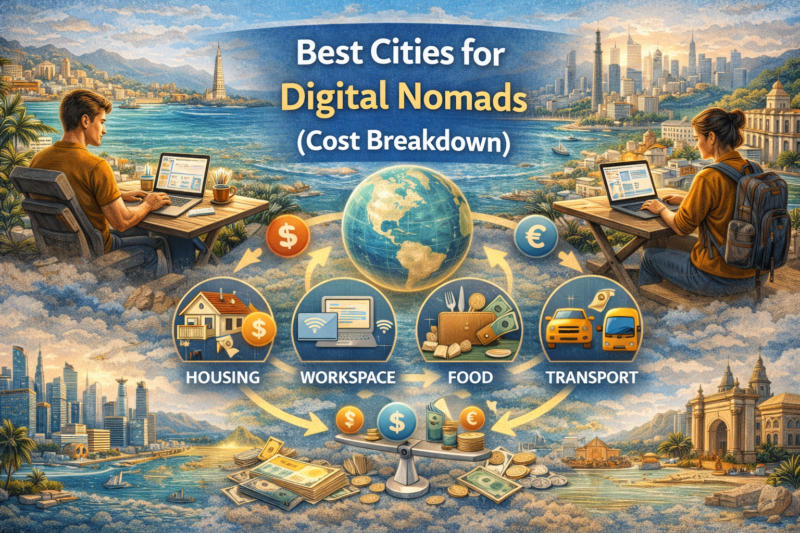
What Actually Drives Your Costs
Across all these cities, a few patterns show up consistently.
Accommodation is almost always the biggest expense. Choosing between short-term rentals and longer leases can significantly impact your budget.
Food is the second major factor. Eating local tends to keep costs low, while relying on international options adds up quickly.
Transport, coworking spaces, and lifestyle choices fill in the rest. These are more flexible and depend on how you prefer to live and work.
A Quick Monthly Cost Snapshot
Here’s a simplified overview to give you a sense of relative costs:
- Budget-friendly cities: $800 to $1,500 per month
- Mid-range cities: $1,200 to $2,000 per month
- Higher-cost hubs: $1,800 to $3,000 per month
These ranges assume a relatively comfortable lifestyle, not extreme budget travel or luxury living.
Choosing the Right City for You
There isn’t a single “best” city for every digital nomad. It depends on what you prioritize.
If your goal is to minimize expenses, Southeast Asia and parts of Eastern Europe offer strong value. If you want a more developed environment with fewer trade-offs, Western Europe or major Latin American cities might be a better fit.
Personally, I’ve found that spending slightly more for a place that fits your lifestyle often leads to better productivity and less stress. Saving money is important, but not at the cost of your day-to-day experience – especially if you’re an expat dad.
Conclusion
The best cities for digital nomads are not just the cheapest ones. They are the ones where your money goes further in a practical sense.
That means reliable internet, comfortable living conditions, and an environment where you can actually focus on your work while enjoying your surroundings.
Costs will always vary, and prices continue to change as destinations grow in popularity. But if you understand what drives those costs, you can make smarter decisions and build a setup that supports both your work and your lifestyle.