Best VPN for Digital Nomads


Key Take-Aways
- A VPN needs high speeds to keep video calls, website edits, downloads and other parts of your business smooth and safe while working abroad.
- Focus also on encryption and no-logs policies, they’re essential for public network safety – never underestimate the importance of digital privacy.
- Global server networks improve stability for international travel, absolutely required for us digital nomads.
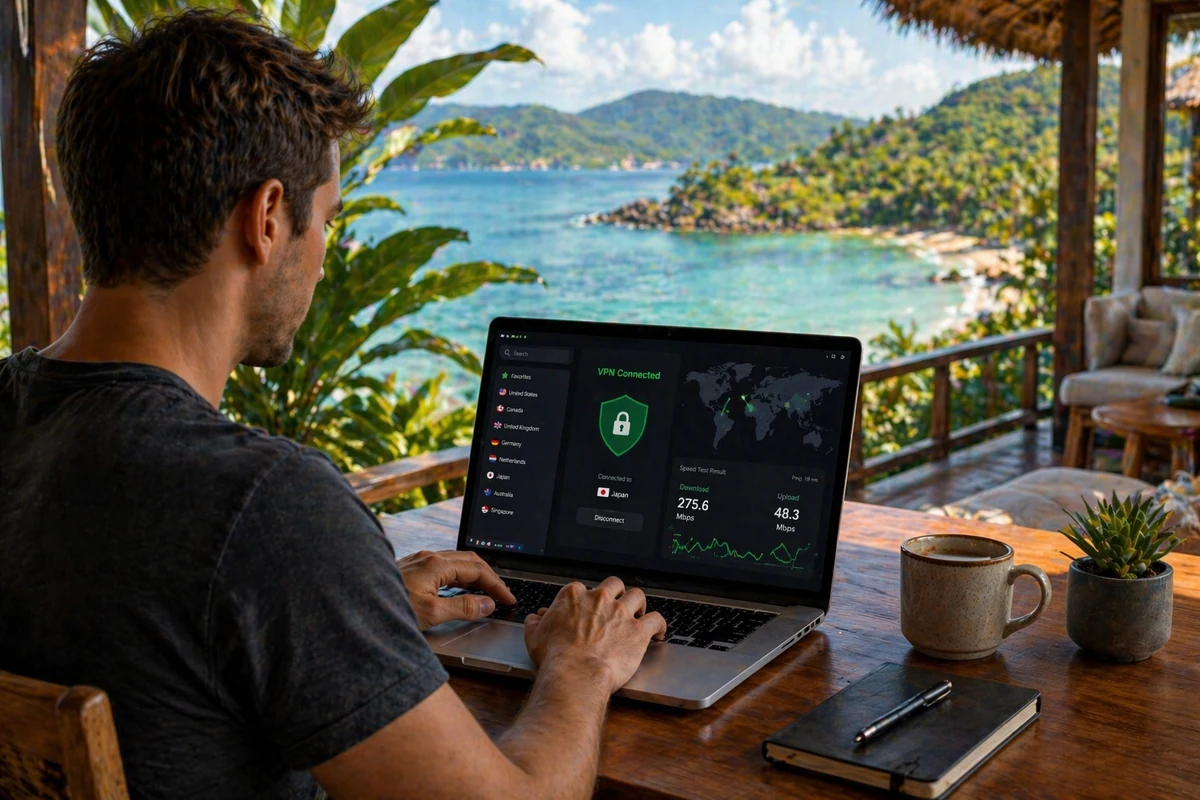
If you’re like me and you find yourself on occasion working remotely from airports, cafés, AirBnBs or coworking spaces around the world, a VPN becomes one of the most important tools in your digital toolkit.
A virtual private network protects your connection on public Wi-Fi, secures sensitive data like passwords, and gives you more control over your online presence when you are hopping between countries.
I’ve been using a quality VPN for years, and I can’t recommend it enough. The cost is negligible if you purchase multi-year plans, and while it’s easy to dismiss a VPN as “not required”, you really can’t put a price on digital safety – especially as a nomad.
There are other advantages, which we’ll tackle in this guide.
But not all VPNs are created equal, especially when it comes to the two things that matter most for digital nomads: fast performance and strong security.
Having lived and worked across multiple continents, I quickly learned that some (cheaper or free) VPNs slowed down my connection so much that websites edits wouldn’t go through, videos wouldn’t render, or calls were just painfully stilted and slow.
Fortunately, a handful of VPNs stand out as reliable options for people who need both performance and peace of mind while traveling.
What Makes a VPN Great for Nomads
First off, why do you need a VPN as a nomad? There are several reasons, and I’ll list them briefly, based on my experience:
- Digital safety – the biggest one. You don’t want random amateur hackers to be able to get into your system. Sometimes you just have to access your online finances when on a public network, and that’s a really, really bad idea without a VPN (even with it, I’d recommend you try to avoid it as much as possible). A random example: a few months ago I was stranded in an airport due to a delayed flight and I had to rebook and thus repurchase a new ticket. I have zero faith in the safety of the Manila international airport’s free WiFi, so turning on my quality VPN gave me at least one strong layer of protection.
- Digital privacy. I’m a private person, and while I realize that if a government agency really, really wants to track my internet traffic, downloads etc., they could, even when I’m using a VPN – but they’ll have to do quite a bit of work. And random companies or individuals have virtually no chance of invading my digital privacy – a very comfortable thought.
- Access to other GEOs. I have no idea what kind of work you do, but I’m involved in a few projects that are blocked in certain areas of the world. Some sites or platforms I just cannot access if I’m in Southeast Asia/Latin America, which makes research and reviews plainly impossible without a VPN.
What does a VPN need to handle?
When you are traveling and working on the go, your VPN needs to handle a few core tasks well.
First, it must protect your data with robust encryption (specifically the AES-256 standard) and a strict no-logs policy so that your information is not shared without your consent.
| Feature | Importance for Nomads |
| No-Logs Policy | Ensures your activity is never recorded or stored. |
| Global Servers | Keeps latency low by connecting to nearby nodes. |
| Modern Protocols | Essential for a VPN with fastest connection speeds. |
Independent audits of no-logs claims provide extra reassurance that a provider truly protects privacy.
Next, performance is crucial. Using modern protocols helps maintain high speeds during video conferences.
This is vital whether you are freelancing or have a remote job where uptime is a professional requirement.
NordVPN: Reliable, Fast, and Secure
Let’s start with my personal favourite and #1 recommendation as the best VPN for digital nomads: NordVPN.
But don’t just take my word for it, it often appears near the top in tests focused on both fast travel VPN performance and security.
Its implementation of WireGuard through the NordLynx protocol is designed to give you excellent performance on a wide range of servers, which is important if you connect from distant countries.
- Security: AES-256 encryption and digital privacy for expats features.
- Performance: Consistently low speed loss on international connections.
- Stability: Reliable kill switch to protect your data and privacy if the VPN’s connection unexpectedly drops (it automatically breaks the internet connection as well, so you’re never exposed without protection).
In recent benchmark testing, NordVPN had a minimal impact on download and upload speeds. This is exactly what you want – a performance which makes it easy to handle video calls and large file transfers without lag.
It is widely considered a top rated VPN for digital nomads because it preserves the original connection speed while keeping your activity private even on unsecured networks.
Just what you want (and need!)
Surfshark: Budget-Friendly With Solid Performance
If you are budget-conscious but still want the best VPN for digital nomads, Surfshark is a compelling choice, just not my preference.
It consistently ranks highly in recent tests, delivering strong performance with minimal speed loss compared to baseline connections.
- Unlimited Connections: Secure your laptop for remote work, phone, and tablet on one plan.
- Privacy: RAM-only servers that wipe data upon restart.
- Value: A smart addition to your list of the best budgeting apps for digital nomads.
Surfshark also includes a kill switch and obfuscation tools to help you use the internet safely in restrictive regions.
Proton VPN: Balanced Security and Speed
Proton VPN is one service I haven’t got much personal experience with.
It has made strides in recent tests, especially with its speed performance using modern protocols and network acceleration tools, so at least in theory it’s a cracking option too.
Recent evaluations even show that it can rival top competitors in both download and upload performance.
- Split Tunneling: Manage traffic through VPN split tunneling for better performance.
- Encryption: High-level standards focused on secure core routing.
- Privacy: Swiss-based jurisdiction with a strict audited no-logs policy.
Proton VPN also includes tools that let you choose which traffic goes through the VPN. This is helpful if you want sensitive data protected while allowing other traffic to use your regular connection for speed.
How to Choose the Right VPN for Your Travel Style
Choosing the right service is not just about the highest scores or my recommendations.
Think about how you work and travel.
- If you spend most of your time in one region, prioritize a provider with many local servers there to keep up performance.
- If you have projects like mine, where you need access to regions far away from where you are, then you may need a service that has a broad network.
- If you rely on large file uploads or downloads, a VPN with fastest connection speeds and low latency is your top priorities.
- Consider how easy the app is to use across your platforms. I’m just using it on my laptop and PC, but you might have plenty of others.
The service also needs to hit AT LEAST the standard (and in my opinion, the highest) levels of reliability, security and privacy. That’s a must, before you start looking at your own variables.
Conclusion
In summation, and I hope I’ve made it very clear: for serious digital nomads, a VPN is not optional.
I think it’s an essential part of your travel and work toolkit.
While you can of course get away without one, I think in this day and age it’s madness to not just spend a few bucks a month to protect your data on public networks, keep your online identity secure, and let you access region-specific services from anywhere you roam.
Remember: it only takes one data leak or hack to completely screw you over financially and/or professionally. Image how stupid you’d feel when that happens to you, knowing you could have avoided it by just getting the best VPN for digital nomads.
I personally prefer and recommend NordVPN, but other options like ExpressVPN and Surfshark are fine too. They all offer strong combinations of speed, security, and usability, I just think NordVPN is the best.