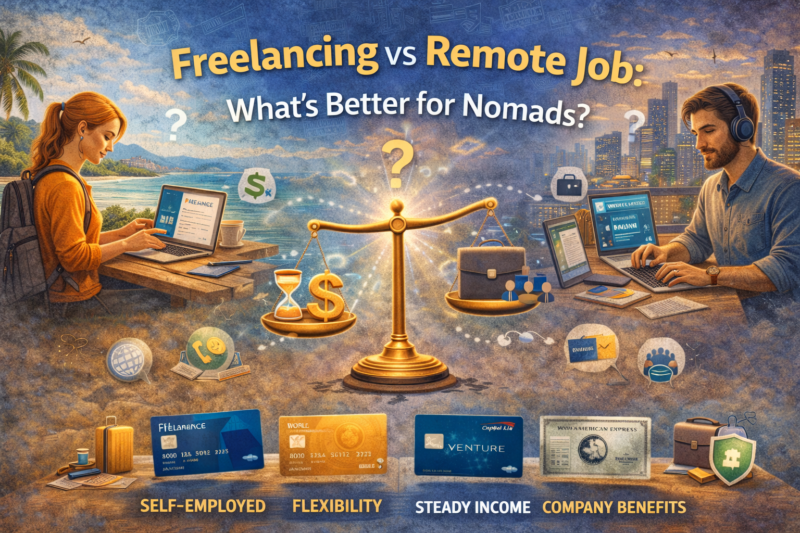
Freelancing vs Remote Job: What’s Better for Nomads?
TLDR
- Remote jobs provide stable income, structured responsibilities, and often employee benefits, which support predictable financial planning.
- Freelancing offers higher flexibility, income scalability, and full autonomy, but comes with variable earnings and self-managed responsibilities.
- Freelancers must handle taxes, insurance, and client acquisition themselves, while remote employees typically receive employer support.
- Risk tolerance, income goals, and personality type play a major role in choosing the right path.
- Many nomads combine both models to balance financial security with independence.
If you want to live and work from anywhere, you usually face one big decision early on. Do you build a freelance career, or do you land a remote job with a company?
Both paths can fund a location independent lifestyle. Both can allow you to work from Bangkok one month and Bogota the next. But structurally, financially, and psychologically, they are very different.
The right choice depends less on trends and more on how you prefer to earn, manage risk, and design your days. Let’s break it down properly so you can decide with clarity.
Income Stability and Predictability
One of the clearest differences between freelancing and remote employment is income structure.
A remote job typically provides a fixed salary paid on a regular schedule. That predictability makes budgeting easier. You know how much is coming in, you can automate savings, and you can plan rent, travel, and investments with fewer surprises.
Freelancing works differently. Income depends on clients, contracts, and workload. Some months are strong. Others are lighter. Payment timelines can vary depending on client terms and invoicing cycles.
This variability is not inherently bad. In fact, many freelancers eventually out-earn traditional employees. But the income curve can be uneven, especially in the early stages.
If you value consistent cash flow and financial predictability, remote employment usually offers a smoother foundation.
Flexibility and Control Over Your Schedule
Freelancing wins clearly in one area: autonomy.
As a freelancer, you decide who you work with, what projects you accept, and often when you complete them. If you want to take two weeks off to travel slowly through Thailand, you can structure your workload around that.
Remote jobs can also offer flexibility, but you are still part of a company system. There are meetings, team expectations, and sometimes time zone requirements. Even fully remote roles often require availability during specific hours.
If you thrive with independence and self direction, freelancing may feel more aligned. If you prefer structure and collaborative environments, remote employment can provide that framework.
Benefits and Employer Support
Remote employees often receive benefits that freelancers must secure on their own.
Depending on the company and country of employment, this may include paid time off, health insurance, retirement contributions, parental leave, maybe even a laptop or other perks. Even when benefits vary by contract type, having employer-managed payroll and tax documentation reduces administrative complexity.
Freelancers operate as independent businesses. You are responsible for your own insurance, retirement savings, accounting, and tax compliance. That does not make freelancing worse, but it does require more financial organization.
From a long term wealth building perspective, remote jobs can make it easier to automate retirement contributions and maintain stable savings habits. Freelancers need to build those systems intentionally.
Income Growth Potential
Freelancing offers theoretically unlimited upside.
You set your rates. You choose how many clients you take on. You can increase pricing as your skills and demand grow. Some freelancers scale into agencies or productized service businesses, expanding beyond solo work.
Remote jobs generally follow more structured compensation paths. Raises, bonuses, and promotions depend on company policies and performance reviews. Growth is possible, but it is often incremental rather than exponential.
If maximizing earning potential is your primary objective and you are comfortable with business development, freelancing may offer more upside. If you prefer predictable progression within an organization, remote employment may feel safer.
Risk and Financial Resilience
Risk tolerance is where this decision becomes very personal.
Freelancing carries business risk. You can lose clients. Contracts can end abruptly. Market demand can shift. That means you need a larger emergency fund and stronger cash flow management.
Personally, I’ve had situations where from one year to the next I lost 90% of my income, having to rebuild it steadily.
Remote employment spreads some of that risk across the company. While layoffs do happen, especially in economic downturns, you are not individually responsible for sourcing revenue. But it is completely possible that you, at some point, out of your control, lose 100% of your income.
From a financial planning standpoint, freelancers should typically maintain a larger emergency fund compared to remote employees. Income volatility requires a stronger buffer.
If stability reduces your stress and improves your performance, a remote job may suit you better. If you are comfortable navigating fluctuations, freelancing can be rewarding.
Workload and Mental Bandwidth
Freelancing is not just doing client work. It also includes marketing, sales calls, invoicing, contract negotiation, and sometimes dispute resolution.
Those tasks take time and mental energy. Some people enjoy the business building aspect. Others find it draining.
Remote employees generally focus on their assigned role. Sales, operations, and client acquisition are handled by other departments. This allows you to specialize deeply without constantly seeking new work.
In my own experience, freelancing felt exciting when landing new clients, but mentally heavier when juggling multiple contracts and chasing payments.
A remote role simplified my daily workload and freed up energy for travel planning and personal development, but it’s definitely more soul-draining in the long run due to the lack of personal agency.
Neither path is objectively easier. They are demanding and rewarding in different ways.
Geographic and Legal Considerations
Freelancers often have greater location freedom because they are not tied to a specific employer jurisdiction. As long as clients are satisfied and contracts allow it, you can move relatively freely.
Remote employees sometimes face restrictions depending on company policies, tax regulations, or employment laws. Some employers limit the countries from which you can work due to compliance or payroll complexity.
Before committing to either path, review the legal and tax implications of your status. Freelancers must manage cross border tax obligations carefully. Remote employees should confirm where they are legally permitted to work.
Mobility matters for nomads. Make sure your income structure aligns with your travel ambitions.
Career Development and Skill Building
Remote jobs often provide structured training, mentorship, and internal advancement opportunities. You may gain exposure to larger systems, cross functional teams, and leadership pathways.
Freelancers develop differently. Growth comes from market positioning, skill refinement, client results, and reputation building. Instead of climbing a corporate ladder, you build a personal brand and network.
If you value formal career pathways and corporate experience, remote employment offers clearer frameworks. If you enjoy entrepreneurial growth and self direction, freelancing provides broader creative control.
Can You Combine Both?
Yes, and many nomads do.
Some professionals hold a remote job for stability while freelancing on the side to diversify income. Others start freelancing full time and later accept a remote role for consistent pay while scaling a business slowly.
This hybrid model reduces financial pressure while preserving autonomy. It requires discipline and time management, but it can offer the best of both worlds.
For many people, the choice is not permanent. It evolves with life stages, financial goals, and risk appetite. I’ve bounced between both paths in the past, before fully settling on being my own boss and not working for others anymore.
Conclusion
Freelancing and remote employment both support location independent living, but they are built on different foundations.
Remote jobs offer stability, predictable income, and structured support. Freelancing delivers autonomy, scalability, and entrepreneurial control. One favors security and structure. The other favors independence and income flexibility.
The better option depends on your personality, financial resilience, and long term goals. If you prioritize stable cash flow and benefits, remote work may suit you. If you crave autonomy and are comfortable managing business risk, freelancing can be powerful.
Many successful nomads move between both paths over time. What matters most is that you understand the trade offs and design your income strategy intentionally.
Because freedom without structure creates stress, and structure without freedom can feel limiting. The goal is to build a system that supports both mobility and financial strength.