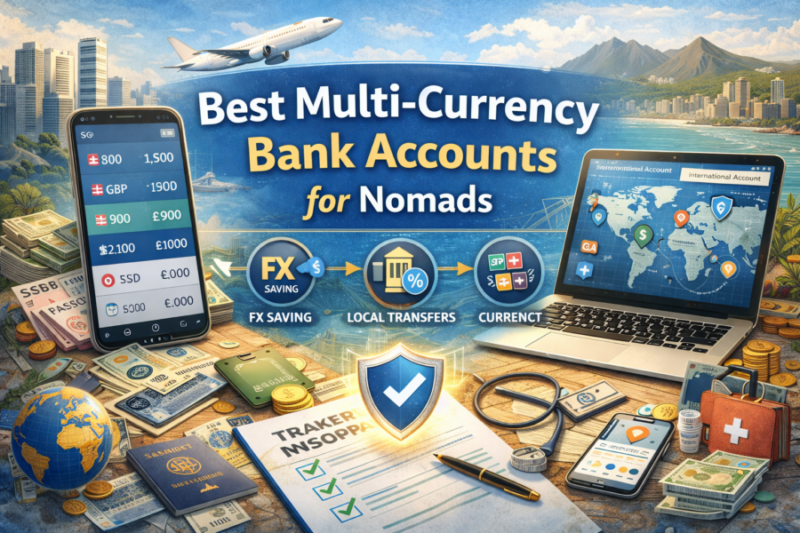
Best Multi-Currency Bank Accounts for Nomads
TLDR
- Wise is widely regarded as the most transparent and flexible multi-currency account option.
- Revolut blends multi-currency access with travel-friendly features and spending tools.
- N26 offers full banking with eurozone benefits for nomads spending much of their time in Europe.
- Payoneer is effective for freelancers and remote workers who receive international payments.
- Other global account options can help you tailor banking to specific regions or business needs.
Managing money while you move around the world can be surprisingly tricky. Standard bank accounts from a single country often charge you extra fees whenever you spend or transfer money abroad.
That adds up fast – especially when you’re earning in one currency, spending in another, and switching between cost-of-living regions.
That’s where multi-currency bank accounts come in. They let you hold multiple currencies at once, make conversions at more competitive rates, and often give you local receiving details like IBANs or routing numbers so you can get paid more efficiently.
Below, we break down some of the most nomad-friendly options today, how they work, and what they’re best suited for.
Wise Multi-Currency Account
If there’s one platform most nomads talk about first, it’s Wise. Rather than being a traditional bank, Wise offers a regulated financial account that lets you hold, send, and receive money in more than forty currencies under one login.
You can receive local bank details in major regions – not having to rely on costly SWIFT payments each time makes a big difference for freelancers and contractors paid internationally.
The key strength of Wise is transparency: their currency conversion generally uses the mid-market exchange rate with a small, clearly stated fee. That’s significantly cheaper than most traditional banks and many legacy international transfer services.
It also means you can wait to convert currencies until the rate suits you, rather than being forced to exchange every payment immediately. In practice, this flexibility can save you meaningful amounts over time, especially if you’re moving money between business accounts, savings, and spending balances.
In terms of spending and cash access, Wise provides a debit card that works in many countries worldwide. There are typically a couple of fee-free ATM withdrawals per month up to a limit, after which small withdrawal fees apply.
For many nomads, this combination – multi-currency balances, local receiving numbers, and a global debit card – makes Wise a powerful core account for your financial setup.
Revolut Global Account
Revolut is different from Wise in that it works more like a digital bank you’d use daily. You can hold and exchange dozens of currencies, spend internationally with low foreign transaction charges, and access tools like budgeting, savings vaults, and sometimes travel perks depending on your plan tier.
Many nomads appreciate Revolut for its broad ecosystem: it’s not strictly about holding currencies, but about everyday money management on the go.
One standout feature is that Revolut often lets you exchange money at near-interbank rates up to a monthly limit without fees, then applies modest charges after that.
Card spending abroad tends to be fee-free (within the rules of your specific plan), and the app gives you real-time notifications whenever you spend or convert. Some plans include extras like travel and purchase protections, which can be a bonus if you want one account to handle most of your financial needs.
Revolut’s debit cards are widely accepted in many countries, which is useful if you’re spending part of the year in regions where card acceptance varies. Do note that plans differ by region and tier, so features like ATM withdrawal limits and travel perks can change as you move between plans.
N26 Digital Bank
N26 is a full-license digital bank based in Germany and available across much of Europe. As a licensed bank rather than just a fintech wallet, it includes traditional banking protections like deposit insurance (up to defined limits) and a standard IBAN for EU transactions.
That makes it especially appealing if you spend large chunks of time in eurozone countries.
While N26’s multi-currency support is not as broad as some fintech wallets – it’s most powerful for euros and often centered around that currency – the convenience of a fully regulated European bank account can be huge.
You typically get free card payments across Europe, fee-free ATM withdrawals up to certain limits depending on your plan, and a slick mobile app for everyday money management.
For nomads who base themselves in European hubs for extended periods, N26 can act as a reliable primary account for local spending, bill payments, and euro-centric transactions – while you might keep a second account elsewhere for non-euro currency handling.
Payoneer International Payments Account
Payoneer isn’t a bank in the traditional sense, but for freelancers and remote workers, it plays a crucial role in managing international earnings.
Instead of routing every payment through SWIFT and incurring high fees, Payoneer lets you receive money from clients and marketplaces around the world using local receiving account details.
That means clients in the United States, Europe, or the UK can pay you as if you were local, without triggering costly bank transfers.
Once funds are in your Payoneer account, you can move them to your local bank, spend via a debit card where available, or use the platform’s tools to make payments in other currencies.
For people who earn a significant portion of their income online – whether freelancing, consulting, or running an e-commerce business – this type of account can streamline cash flow and reduce conversion costs.
Nomads often treat Payoneer as a complement to a primary bank account. By combining a platform that’s great for receiving payments with a multi-currency account that’s strong for everyday spending, you get the best of both worlds without unnecessary fees.
Charles Schwab (For U.S. Nomads)
If you’re a U.S. citizen or green card holder on the nomad path, Charles Schwab’s High Yield Investor Checking account is worth mentioning even though it’s technically a single-currency account.
It doesn’t offer broad multi-currency balances, but it compensates in other ways that matter for international living. Namely, it refunds ATM fees worldwide and doesn’t charge foreign transaction fees on card purchases. That’s a killer perk if you prefer a U.S.-based checking account but travel frequently.
While it isn’t multi-currency per se, many U.S. nomads use Schwab alongside a fintech multi-currency wallet so they can cover both local cash needs and international payments without being buried in ATM fees.
Considerations When Choosing an Account
Picking the right account isn’t just about the number of currencies supported. You need to think about how you earn, where you spend, and how you want to access your money.
For example, if most of your income comes from international clients paid in U.S. dollars, having an account that lets you receive local dollar payments without swap fees can save you a lot over time.
Wise’s local receiving capability in regions like the U.S. and Europe fits that scenario well. On the other hand, if you spend a lot of time in Europe and want a traditional bank experience with deposit protections and full IBAN functionality, N26 might fit better.
It’s also important to understand fee structures. Some accounts have monthly subscription costs, while others charge based on usage.
Many fintech multi-currency accounts have no monthly fee but can apply small conversion fees, ATM withdrawal fees beyond a certain limit, or weekend markups on currency exchanges. Knowing these details helps you plan ahead rather than getting surprise costs later.
Another practical tip many nomads use is to combine accounts rather than relying on just one. A common setup is to use one multi-currency account for holding and transferring money, and another bank or card product for daily spending or cash access where needed.
That way, you avoid over-exposure to a single provider’s restrictions or fee schedule.
Conclusion
Modern multi-currency accounts have transformed how location-independent professionals manage money. Whether it’s holding multiple currencies, converting at competitive rates, receiving local payments, or simply spending abroad without huge fees, the right account makes everything easier.
Wise is often the go-to for flexible multi-currency handling and transparent fees. Revolut brings extra features and travel tools. N26 gives a full banking experience in Europe. Payoneer excels at getting you paid by global clients.
And options like Charles Schwab still have unique strengths depending on your citizenship and travel patterns.
Your best strategy is to match your account choice to how you earn and where you spend. That blend – combined with a thoughtful view of fees and access – keeps your money working for you, not against you, as you build your nomadic lifestyle.
Blog
-
Freelancing vs Remote Job: What’s Better for Nomads?
If you want to live and work from anywhere, do you build a freelance career, or do you land a remote job?
-
Top Travel Credit Cards for Digital Nomads
If you travel regularly while earning remotely, the right credit card is one of your most useful financial tools.
